


Key Takeaways
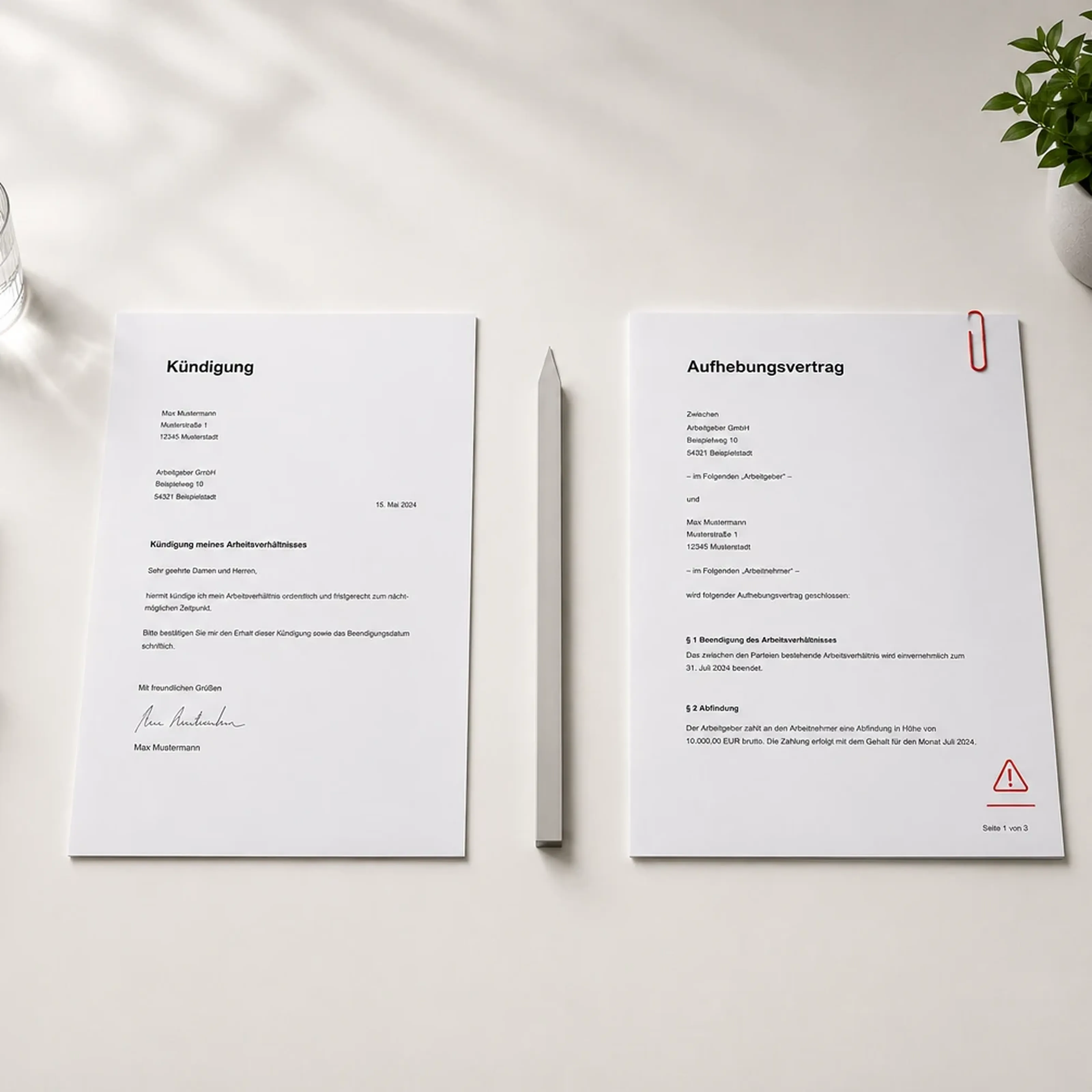
Kündigung vs. Aufhebungsvertrag: A Kündigung (employer dismissal) ends your job without your signature; an Aufhebungsvertrag (mutual termination agreement) ends your job because you sign.
The 3‑week lever: If you want to challenge a Kündigung, you usually have 3 weeks to file a Kündigungsschutzklage (unfair dismissal claim) — miss it and you often lose leverage.
ALG I risk: Signing an Aufhebungsvertrag can trigger a Sperrzeit (benefit block) for Arbeitslosengeld I (ALG I) unless a “wichtiger Grund” (important reason) is accepted.
Registration deadline: Register as job‑seeking (arbeitssuchend) 3 months before your last day — or within 3 days if you learn the end date later / sign an agreement that ends sooner.
Written form is mandatory: Termination and termination agreements require wet‑ink paper form under § 623 BGB; electronic form is excluded.
You do not have to sign on the spot: Pressure is a red flag. A rushed signature is how people lose money, runway, and rights.
Receiving a termination notice in Germany is a jarring experience, often exacerbated by the language barrier and the complex nature of the German legal system.
For expats, the situation is further complicated by the intersection of employment law and immigration status.
This guide is for English‑speaking expats who need a clear plan. By understanding your rights, the statutory protections afforded to employees, and the procedural requirements set by the German authorities, you can turn a moment of crisis into a controlled, strategic move.
What we’ll cover:
what you must do first
what mistakes cost you money or status, and
how to regain control fast.
Quick legal note
This is general information, not legal advice. Small facts change outcomes in German employment law, especially when ALG I eligibility, immigration status, a Betriebsrat (works council), or special protections are involved. If you are unsure, get employee‑side advice before you sign anything or let deadlines pass.
Understanding Your Rights in the German Workplace
In Germany, the workplace is governed by a strict set of regulations designed to provide stability for employees. Unlike jurisdictions with "at-will" employment, Germany views an employment contract as a protected legal arrangement.
When an employer initiates a termination, they are subject to rigorous scrutiny by labor courts. Your goal is to understand how these protections apply to your specific situation and to ensure your rights are not bypassed during high-pressure moments.
The Foundation of Your Protection: Kündigungsschutzgesetz
The Kündigungsschutzgesetz (Unfair Dismissal Protection Act) is your primary shield against arbitrary job loss. However, this law does not apply to everyone immediately. To benefit from its full protection, you must meet two mandatory requirements:
The Six-Month Rule: You must have been employed with the company for more than six months without interruption. This usually coincides with the end of your Probezeit (probationary period).
Company Size: You must work for a company that regularly employs more than ten full-time staff members. Small businesses with ten or fewer employees are generally exempt from this specific act.
If you meet these criteria, your employer cannot fire you without substantial justification. This creates a significant leverage point. Because employers must prove their case in court—a process that is often long and expensive—they are frequently willing to offer a Abfindung (severance package) to settle the matter quickly.
Navigating the End of Employment
If your employer decides to end the relationship, they will typically use one of two methods. Understanding the difference is vital for your financial and legal security. In extraordinary circumstances, there is also a third option.
1. The Kündigung (Unilateral Termination)
A Kündigung (notice of termination) is a one-sided statement. Your employer tells you the contract is ending.
Your Action: You do not need to sign this to make it valid (which you shouldn’t if you think it was unfair); you only sign to confirm you received it.
The Deadline: If you believe the termination is unfair, you have exactly three weeks from the date of receipt to file a Kündigungsschutzklage (claim for unfair dismissal) in court. If you miss this window, the termination is legally effective, regardless of how flawed it was.
2. The Aufhebungsvertrag (Mutual Termination Agreement)
An Aufhebungsvertrag (mutual termination agreement) is a contract where both parties agree to part ways. Employers prefer this because it waives your right to sue.
The Risk: Signing this can lead to a Sperrzeit (blocking period) of up to 12 weeks for your Arbeitslosengeld (unemployment benefits) because the Arbeitsamt (employment office) views it as you leaving voluntarily.
The Benefit: This is your primary tool for negotiating a higher Abfindung (severance package) and a positive Arbeitszeugnis (job reference).
If you need more on that, visit LINK HERE.
3. The Fristlose Kündigung (Extraordinary Termination)
A fristlose Kündigung (extraordinary termination) is an immediate dismissal without a notice period. Employers use this only in extreme cases, such as alleged theft, fraud, or persistent refusal to work.
The Impact: Your employment ends the moment you receive the letter. You stop receiving your salary immediately, and the Arbeitsamt (employment office) in many cases impose a Sperrzeit (blocking period) on your benefits.
The Legal Bar: The legal requirements for this are very high. An employer must prove that the relationship is so damaged that they cannot be expected to keep you for even one more day. Because of this strict threshold, many of these terminations fail in court.
Your Action: Like the standard termination, you have a strict three-week window to file a Kündigungsschutzklage (claim for unfair dismissal). Given the loss of income and the damage to your professional reputation, acting quickly to challenge the grounds of the dismissal is essential.
The Golden Rule: Do Not Sign Immediately
When presented with any document—especially an Aufhebungsvertrag—your strategy is simple: Do not sign it on the spot.
Employers may pressure you with "urgent deadlines" or "one-time offers." These are tactical pressures. A signature on a mutual agreement is almost impossible to undo and can forfeit your right to state support and legal recourse.
Your Action Steps:
Stay Calm: Take the document and remain professional.
Request Time: State clearly that you need to take the document home to review it and consult with a legal professional.
Verify the Details: Check if you have Rechtsschutzversicherung (legal insurance) or if you need to contact a lawyer privately.
Evaluate: Weigh the offer against your chances in a Kündigungsschutzklage (unfair dismissal claim).
By treating these moments as business negotiations rather than personal crises, you maintain your sovereignty and ensure that any exit from a company happens on your terms.
Quick Assessment: Identify Your Situation
In the high-pressure moment of receiving bad news, it is easy to feel overwhelmed. Use this logic to identify exactly which document is on your desk and what your immediate priority should be
If you see or hear... | Then you are likely facing... | Your immediate priority |
|---|---|---|
A request to sign a document to "part ways amicably" or "end the contract by mutual consent." | Aufhebungsvertrag (Mutual Termination Agreement) | Do not sign. Take the document home. Signing this is a voluntary act that can trigger a Sperrzeit (blocking period) for your benefits. |
A formal letter stating your employment will end on a specific future date, citing a notice period. | Kündigung (Ordinary Termination) | Check the clock. You have exactly three weeks from the day you received it to file a Kündigungsschutzklage (claim for unfair dismissal). |
A letter using terms like "fristlos," "außerordentlich," or "with immediate effect." | Fristlose Kündigung (Extraordinary Termination) | Seek legal advice immediately. Your salary stops today, and your benefits are at risk. You must challenge this within the three-week window to protect your rights. |
A document mentioning a "settlement" or "severance" in exchange for not going to court. | Abwicklungsvertrag (Settlement Agreement) | Review the fine print. This often follows a Kündigung. Like the Aufhebungsvertrag, it requires your signature and careful negotiation to avoid issues with the Arbeitsamt (employment office). |
Other things to take care of NOW
Registering as Job-Seeking (Arbeitssuchend)
The moment you receive a termination notice, you must register with the Agentur für Arbeit (Federal Employment Agency) as arbeitssuchend (job-seeking). This is not the same as applying for unemployment benefits—it is a separate, mandatory reporting requirement.
The Timeline:
If you receive notice with a future termination date: Register within 3 days of receiving the notice
If your job ends within 30 days: Register immediately
If you fail to register on time: The Agentur für Arbeit can reduce your future Arbeitslosengeld I (unemployment benefits) by up to one week
How to Register: You can complete this online through the Agentur für Arbeit portal or by phone. You will need your termination letter and employment contract. The process takes approximately 15 minutes, but the consequences of missing it last months.
Why This Matters for Expats: This registration maintains the continuity of your social security record and is a key condition for receiving full unemployment benefits without reductions. German bureaucracy operates on strict timelines—missing this deadline signals to the system that you were not genuinely seeking work.
Immigration Reporting Requirements
If your residence permit depends on employment (Aufenthaltserlaubnis tied to work), losing your job triggers immediate reporting obligations to the immigration authorities (Ausländerbehörde).
The Berlin Example: In Berlin, the LEA (Landesamt für Einwanderung) requires notification within 2 weeks of learning your employment will end early. Other states may have different timelines, but the principle remains consistent across Germany.
What You Must Report:
The date your employment ended or will end
Whether you have found new employment
Your current address and contact information
The Risk: Failing to report can result in your residence permit being revoked or not renewed. Immigration authorities view unreported job loss as a breach of your permit conditions, which can affect future visa applications.
Your Action: Contact your local Ausländerbehörde immediately. Many offices allow online reporting or email notification, but confirm the accepted method for your jurisdiction. Keep written proof of your notification.
Building Your Documentation File
Create a comprehensive file of all termination-related documents. This will be essential for unemployment benefit applications, potential legal proceedings, and future job searches.
Essential Documents:
Original termination letter with receipt confirmation
Employment contract
Salary statements from the last 12 months
Any performance reviews or disciplinary notices
Email correspondence related to the termination
Notes from the termination meeting
The Digital Backup: Scan everything and store copies in multiple locations. If you proceed with legal action, your lawyer will need complete documentation, and German courts expect thorough record-keeping.
Validity Check: Is Your Exit Even Legally Effective?
Before you debate whether your termination is "fair" or "unfair," run a quick validity check. In Germany, a termination can fail completely because your employer missed a formal requirement. This doesn't mean you should relax—it means you may have leverage if you act in time.
The Core Idea
A valid termination is a process, not just a decision. Your employer might have a compelling story, but courts and authorities still care whether the procedural rules were followed.
Paper Form Required (Schriftform)
Under § 623 BGB, ending an employment relationship through Kündigung (dismissal) or Aufhebungsvertrag (mutual termination agreement) requires written form on paper. Electronic form is explicitly excluded.
What counts as valid:
Paper document with original handwritten signature
Physical delivery or registered mail
What doesn't count:
Email termination
WhatsApp, Teams, or Slack messages
Fax transmission
"Signed PDF" sent by email
Scanned documents with digital signatures
If you only received a digital message or scan, treat it as a draft rather than the end of your job. However, still protect your deadlines—the employer might follow up with proper paperwork.
Works Council Check (Betriebsrat)
If your company has a Betriebsrat (works council), the employer must consult them before every dismissal under § 102 BetrVG. If they skip this step, the dismissal becomes ineffective—regardless of how justified the employer's reasons might be.
This procedural requirement often becomes a leverage point. Even when you don't want the job back, procedural violations frequently change settlement dynamics in your favor.
Green flag: Employer confirms the Betriebsrat was properly consulted Red flag: HR says "doesn't matter" or "we didn't need to involve them"
Your 10-Minute Checklist
Run through these questions immediately after receiving any termination notice:
Form Requirements:
Do you have the paper original document?
Does it have a handwritten signature (not scanned)?
Can you prove when you received it (Zugang date)?
Did you keep the envelope if delivered by mail?
Procedural Requirements:
Does your company have a Betriebsrat?
If yes, was the Betriebsrat consulted before your dismissal?
Are you being pressured to "confirm receipt by email"?
Warning Signs:
Any requests to sign something "today" or under time pressure
Verbal agreements that you're asked to confirm digitally
HR downplaying the importance of proper procedures
If-Then Logic for Quick Decisions
If you only received an email or scan → Then treat it as non-final until proper paperwork exists, but still act as if deadlines could be running.
If a Betriebsrat exists at your company → Then the § 102 consultation process becomes a major leverage point—don't let HR dismiss its importance.
If you're being pushed to sign anything immediately → Then slow down, take the documents home, and get them reviewed by a professional.
Remember: No paper signature means you should treat the situation as unresolved, not as the definitive end of your employment. Document everything, but don't assume you're safe from deadlines.
The Leverage Engine: KSchG + the 3‑Week Lawsuit Window
The core idea
In Germany, you don't "win" a termination case with outrage. You win it with leverage, and leverage comes from understanding exactly where you stand legally and what deadlines control your options.
Two factors determine your negotiating position:
Whether KSchG applies (Kündigungsschutzgesetz - Dismissal Protection Act)
Whether you protect the 3‑week deadline for a Kündigungsschutzklage (unfair dismissal claim). Note that this applies regardless of whether the general protection of KSchG applies (i.e. also in Kleinbetriebe (small businesses))
If you understand these two levers, you stop feeling powerless and you stop making expensive mistakes.
Do you have KSchG protection? (This decides how hard it is to fire you)
What KSchG does — in plain English
If KSchG applies to you, an ordinary dismissal (ordentliche Kündigung) is invalid unless it is "socially justified" (sozial gerechtfertigt). This means your employer must fit the dismissal into accepted legal categories and prove their case.
The two gates (the fast test)
KSchG generally applies if both are true:
Your employment has existed longer than 6 months without interruption
Your employer regularly employs more than 10 employees (with specific counting rules)
Translation: After 6 months in a "real-sized" company, your employer cannot simply end your contract because they feel like it. They must justify it — and they must prove it in court if challenged.
The "10 employees" trap (part-time is counted differently)
The employee threshold is not simple headcount. Part-time employees are counted fractionally (around 0.5 / 0.75 / 1.0 depending on weekly hours). This calculation can decide whether KSchG applies to your situation.
If-Then Logic:If your employer claims "we're under 10" → then don't accept it blindly. Ask how part-time staff are counted and verify the calculation yourself.
What "social justification" means (the three buckets)
If KSchG applies, dismissals must be justified by reasons:
in the person of the employee (personenbedingt) — illness, lack of qualifications
in the conduct of the employee (verhaltensbedingt) — performance issues, policy violations
urgent operational requirements (betriebsbedingt) — restructuring, economic necessity
You don't need to memorize legal doctrine. You need to know this: If KSchG applies, your employer needs a defensible story and a defensible process. Weak stories create settlement opportunities.
The 3‑Week Deadline (Kündigungsschutzklage): your strongest lever
The rule (official, strict, non-negotiable)
If you want to claim that a Kündigung is invalid, you must file a lawsuit at the labor court within 3 weeks after you receive the written termination. This rule is codified in § 4 KSchG.
What matters is "Zugang" (receipt), not the date printed on the letter. Keep your envelope and document exactly when you received the termination notice.
Why this deadline is a "leverage engine" (not just a lawsuit)
A Kündigungsschutzklage is often filed even when the employee does not want to return to work. Why? Because filing creates immediate pressure and forces the employer into risk management mode — which frequently leads to settlement negotiations.
Key principle: Filing is often the step that transforms "take it or leave it" into "let's negotiate terms."
If-Then: should you file even if you're negotiating?
If you are negotiating and the 3‑week deadline is approaching → then preserve your leverage first. Negotiations do not stop the legal clock.
If you miss the deadline → then the termination is typically treated as effective even if it was procedurally flawed or substantively unjustified.
Your Action: Protect the deadline first, negotiate second. You can always withdraw a lawsuit if you reach a satisfactory agreement, but you cannot file one after the window closes.
Don't Navigate This Alone - Get Expert Support Now
Facing job loss in Germany? The 3-week filing deadline isn't just a technicality — it's your lifeline.
Your dismissal doesn't have to be the end of your story. German employment law offers powerful protections, but only if you act fast and act smart. Our employment law specialists understand exactly what expats face: visa concerns, benefit transitions, and navigating a system that feels foreign when you're already vulnerable.
Why choose us:
Expat-focused expertise — We speak your language, literally and figuratively
Proven track record — Successful settlements and court victories for international employees
Complete protection strategy — From Kündigungsschutzklage to visa implications
The clock is ticking, but you're not powerless. Book your free initial assessment today and discover your real options before that 3-week window closes.
Protecting Your Residency: Visa and Permit Survival
For many expats, a Kündigung (termination) or an Aufhebungsvertrag (mutual separation agreement) is more than a career setback—it is a threat to your right to stay in Germany. If your Aufenthaltstitel (residence permit) is tied to your job, you must manage both your employer and the authorities with precision.
1. The Reporting Duty: Who Tells the Authorities?
If you hold a residence permit for employment or an EU Blue Card, the law is very specific about who must report the end of a job.
The Employer's Duty: Under § 4a Abs. 5 Satz 3 AufenthG (Residence Act), your employer must notify the Ausländerbehörde (Immigration Office) within four weeks of learning that your employment has ended prematurely.
Your Duty: While the law does not set a rigid "two-week" deadline for employees, it is an essential Obliegenheit (legal incumbency). In practice, notifying the authorities within two weeks is a standard "safe" window. If you remain silent, the authorities may independently begin the process of revoking your Aufenthaltstitel.
The Goal: Transparency keeps you in control. While not a statutory guarantee, many cities (like Berlin) often grant a "job search period" based on administrative practice. This gives you a window to find a new role without losing your residency status immediately.
2. Check Your Zusatzblatt (Supplementary Sheet)
Your Zusatzblatt is the green paper or digital entry that details your work conditions. It dictates how much freedom you have to move:
If your Zusatzblatt says...Then...Employment is tied to a specific company nameYou cannot start a new job without prior approval from the Ausländerbehörde."Beschäftigung jeder Art gestattet" (Any employment permitted)You can start a new job immediately, though you must still report the change of status.You have held an EU Blue Card for at least 12 monthsYou generally enjoy easier switching options, though you must still notify the authorities of the change.
3. Strategy: Negotiate for "Runway"
When negotiating an Aufhebungsvertrag, your priority is often time, not just an Abfindung (severance pay). The Aufenthaltstitel remains valid as long as the employment relationship officially exists.
Freistellung (Garden Leave): You can negotiate to be released from work duties while remaining officially employed. This Freistellung ensures your permit stays valid while you hunt for a new role.
Extended Notice Periods: Pushing the official end date of your contract into the future buys you the "runway" needed to secure a new sponsor.
Pivot to Language Study: If the job search stalls, you may apply to switch to a permit for a language course, though this requires a separate application and proof of funds.
4. Impact on Permanent Residency
A short gap in employment does not necessarily ruin your path to a Niederlassungserlaubnis (settlement permit). Under § 9 AufenthG, the main requirement is that your Lebensunterhalt (livelihood) is secure.
If you receive Arbeitslosengeld I (unemployment benefits) and are registered with the Agentur für Arbeit (Federal Employment Agency), short gaps are usually acceptable. However, you must ensure you continue to meet the pension contribution requirements.
Action Checklist
Read your Zusatzblatt: Check if your permit is gebunden (tied) to your current employer.
Notify the Ausländerbehörde: Inform them in writing as soon as you have clarity on your end date to avoid an abrupt expiration of your permit.
Register with the Agentur für Arbeit: Do this immediately to secure your benefits and maintain your social security "clock."
Seek Legal Advice: Because immigration and labor law are deeply linked, never sign an Aufhebungsvertrag without confirming how the end date affects your specific visa.
Note: Immigration rules are subject to administrative discretion and vary by city. For official updates, consult the Make it in Germany portal.
Essential Exit Documents
In Germany, the phrase "paper is patient" means everything must be documented to be real. These documents are your currency for future job hunts and your shield when dealing with the Agentur für Arbeit (Federal Employment Agency).
Your Right to an Arbeitszeugnis
Under § 109 GewO (German Industrial Code), you have a legal right to a written Arbeitszeugnis (work reference). You should specifically request a qualifiziertes Arbeitszeugnis (qualified reference).
Unlike a simple confirmation of employment, a qualified reference includes:
A detailed description of your tasks.
An evaluation of your performance.
An assessment of your social conduct.
The Strategy: Do not wait until your last day to see this. If you are negotiating an Aufhebungsvertrag (mutual termination agreement), insist that the final grade and specific wording are agreed upon and attached to the contract.
The Essential Document Checklist
Secure these items before you lose access to your company email or Slack. If you don’t have them, request them in writing immediately.
Document | Why you need it |
|---|---|
Kündigungsschreiben (Termination letter) | You must have the original paper version with a "wet ink" signature to prove the date of Zugang (receipt). |
Arbeitsbescheinigung (Employment certificate) | Your employer is legally required to submit this to the Agentur für Arbeit so your unemployment benefits can be calculated. |
Lohnabrechnungen (Payslips) | Gather your last 12 months of payslips plus documentation for any Bonus (bonus) or Provision (commission) payments. |
Urlaubsnachweis (Vacation proof) | A statement of your remaining Urlaubsanspruch (vacation entitlement) and any Überstunden (overtime) balances. |
Meldebescheinigung zur Sozialversicherung | This confirms your social security contributions were paid; you will need this for your pension records later. |
Reviewing Clauses
Check your original Arbeitsvertrag (employment contract) for two specific traps:
Wettbewerbsverbot (Non-compete clause): If your employer wants to prevent you from working for a competitor, they usually must pay you for that restriction.
Rückzahlungsklausel (Repayment clause): If the company paid for a training or a relocation, check if they are legally allowed to ask for that money back upon termination.
Final Thoughts
Navigating a termination in Germany is a process that requires a measured, informed approach. The German system is designed to provide security, but you must take the initiative to exercise your rights.
By treating the process as a formal, structured transition rather than a personal failure, you protect your professional reputation and your future in Germany.
The key to success lies in three distinct areas:
Legal Compliance: Always honor the three-week deadline for filing an unfair dismissal claim. This single step is the most powerful tool you have to secure a fair exit.
Strategic Negotiation: View the Aufhebungsvertrag as a document to be carefully reviewed, not an immediate sign-off. Leverage the expertise of a professional to negotiate severance and avoid benefit penalties.
Bureaucratic Awareness: Keep the Agentur für Arbeit and the Ausländerbehörde informed. Your residency and social security standing are the bedrock of your life in Germany; protecting them should be your top priority.
As you move forward, focus on the opportunities ahead. Many expats find that a transition period allows them to reset, acquire new skills, or find roles that are better aligned with their long-term career objectives.
Use this time to update your CV, expand your professional network within the German market, and prepare for the next chapter. While the shock of termination is real, the regulatory framework in Germany is on your side—provided you act with intention, consult with professionals, and remain diligent in your paperwork. You have the right to a fair and dignified exit; ensure you exercise it completely.
FAQ
About Us - Allright
Allright is your partner in employment law, dedicated to helping you understand and assert your rights as an employee. We recognize that small uncertainties can significantly impact your work life. That’s where we come in: we assess your situation realistically and guide you step by step through the process.
We know that job-related questions can be unsettling. Our goal is to provide clarity—transparently, digitally, and with a human touch. We explain next steps, deadlines, and options in straightforward language, free of legal jargon.
Allright stands for modern legal support: start online and receive personal assistance from real people. We translate complex legal terms into clear language so you know exactly what’s at stake.
What matters to us
Quick Start: Begin with an online assessment to quickly evaluate your situation and determine next steps.
Direct Contact: Our experts are available for simple, digital communication and clear answers to your questions.
Honest Assessment: We provide transparent insights into your chances and advise when it may be better to pursue a different path.
Whether it's about terminations or other employment law issues, Allright helps you stay calm and act thoughtfully. When it matters most, we represent your interests clearly and reliably.
How can Allright assist You?
Now that you know your key rights, the next step is up to you. With Allright, you can quickly check what your case is worth:
Severance Calculator – Estimate a realistic severance package for your situation.
Free Initial Assessment – Share your circumstances with us for a quick evaluation of your options.
Lawyer Referral – We connect you with experienced employment law attorneys who can review your termination and negotiate on your behalf.
Get your case assessed for free now - turn uncertainty into a plan.